404 - Stress not found!
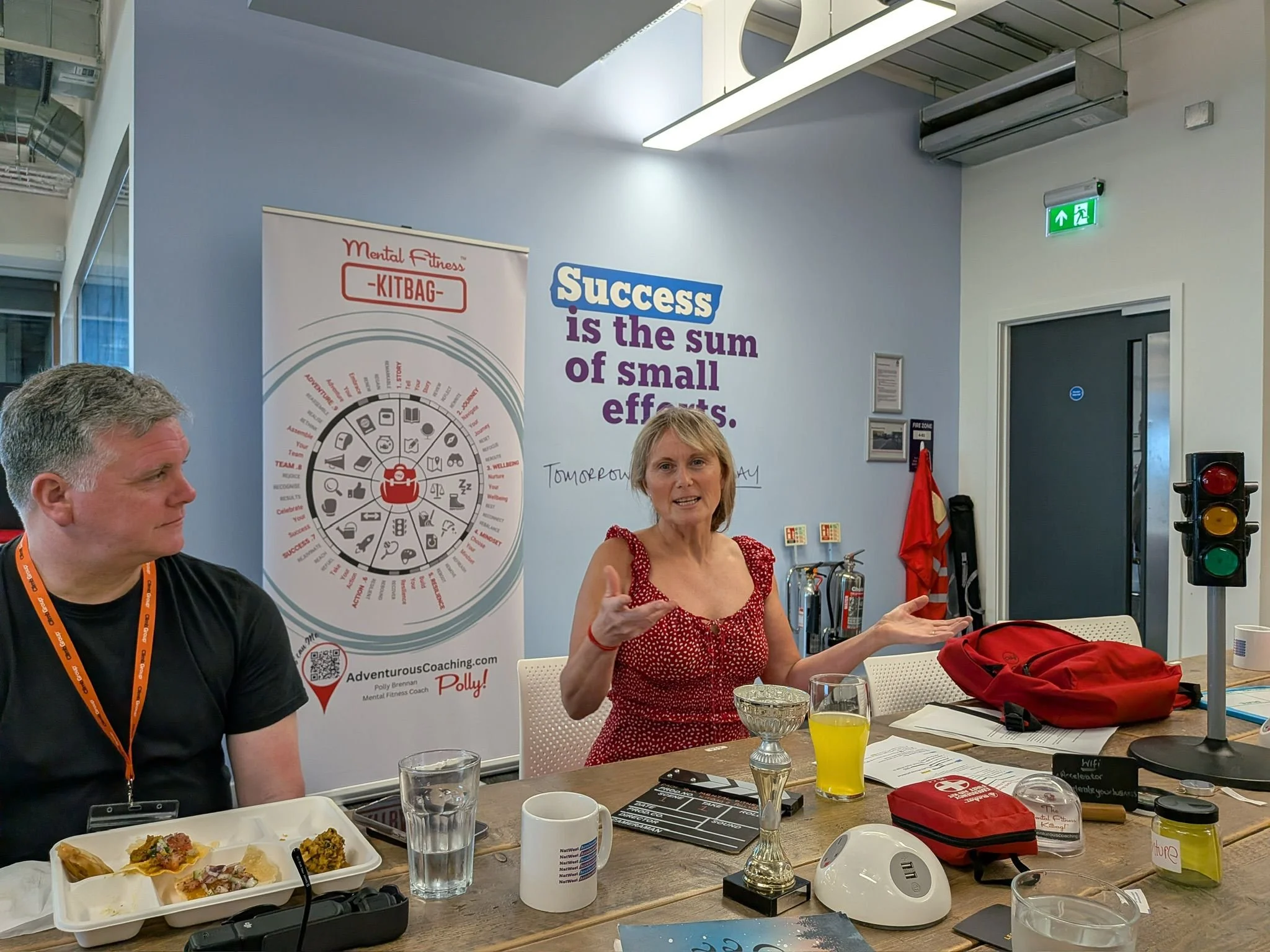
Polly delivering an impromptu workshop with tech professionals
Do you ever find that a lesson learned is actually a re-learn of something you already knew?
This was just one of those moments where life hands you exactly the lesson you needed (just not in the way you expected!)
I was speaking recently at an event about my specialist subject: SOS to SAS. All about packing your mental fitness kit bag and strengthening your mental resilience. I was prepared, ready, and raring to go! Because I genuinely love this stuff. I love getting into a room with people and sharing what I know.
And then, tech failure struck. My slides were gone. And as I looked around the room, I realised the setup wasn't going to work for what I'd planned either. In that moment, I had a choice. Panic or adapt. And it all came down to one of my core strategies:
Adapt. Improvise. Overcome.
I learned this mantra years ago working with military veterans. It's not mine, but I've never let it go because it applies to so much more than a battlefield. It applies to boardrooms, to businesses, to everyday life, and apparently to speaking gigs where your beautiful slides have vanished into thin air!
The thing is, when something goes wrong in a public setting — in front of a room full of people who are watching and waiting — there are two things happening at once. There's the external challenge: how do I handle this situation in a way that still serves the people in front of me? And there's the internal challenge: how do I manage my own stress, think on my feet, and come up with a plan B without falling apart?
Both matter. And both require practice.
The External: Handling The Room
So we pulled the tables together. We sat down. We talked and shared strategies on a really practical level.
Instead of a presentation, we had a workshop! We worked through some of the tools I've developed over the years — the Burnout to Balance Index for leaders and execs who are running on empty, the Traffic Light tool for spotting your stress signature early, the 3B's approach to wellbeing.
But instead of me delivering them at people, we explored them together.
The Internal: Managing Your Own Response
Now for the bit that doesn't always get talked about.
When the plan falls apart, especially publicly, there's a very human temptation to catastrophise and let that inner critic take over. You tell yourself you should have checked the tech, you should have had a backup, you should have known better…
That voice is not helpful. And it's not accurate either.
What actually helped me in that moment was falling back on something I know to be true: discomfort is often the precursor to something better. The moment things stopped going to plan was the moment I had to get out of my head, trust what I know, and let the room lead me somewhere I hadn't expected to go.
The Power Of People In A Room
Here's what I'm always reminded of when things go sideways like this...
When people feel safe enough to share, when we sit together and realise our experiences aren't as unique or as shameful as we thought, something can shift. The isolation lifts, the pressure drops and real, useful, human conversation takes over.
We all have a kit bag. We've all been around long enough to have picked up tools, strategies, and hard-won wisdom that works for us. But when we share that with each other, when we learn from each other rather than just from the person at the front of the room, that's when it gets really powerful.
You Don't Always Need The Fancy Slides
Sometimes the most powerful thing a facilitator can do is get out of the way and let the room talk.
The slides, the visuals, the carefully crafted presentation — they have their place. But they are never, ever the most important thing in the room. The people are. The conversation is. The shared humanity of sitting together and saying yes, me too, that's what people remember long after the event is over.
I was reminded of that last week in the best possible way.
Where Do You Need To Adapt, Improvise And Overcome?
Because this isn't just about speaking events. This is about life.
Where has the thing you planned stopped being the thing you're doing? Where are you gripping too tightly to a plan that isn't working, when a small pivot might open the door to something better? And where might a bit more flexibility — a bit more curiosity about what could happen rather than what should happen — actually serve you better than any amount of preparation?
Plan B gets a bad reputation. But in my experience, Plan B is often where the magic lives.